Paella kits
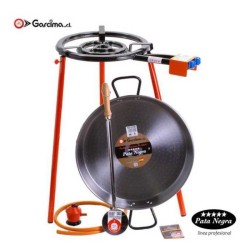

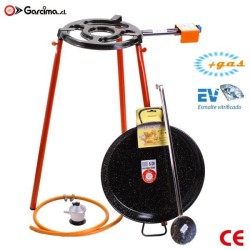

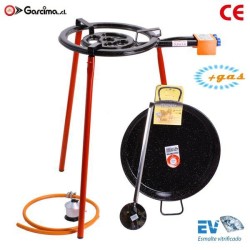

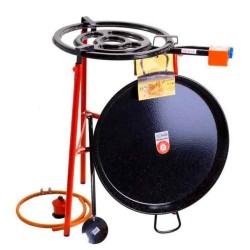

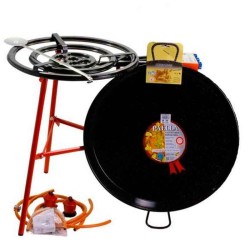
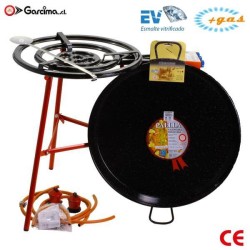
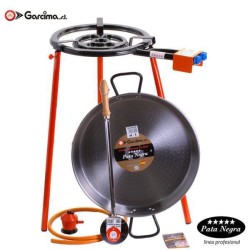
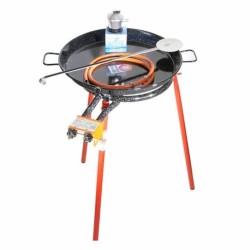
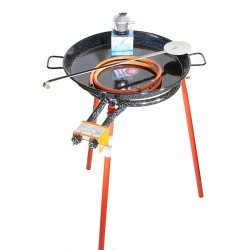
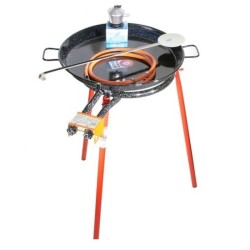
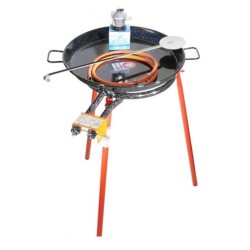
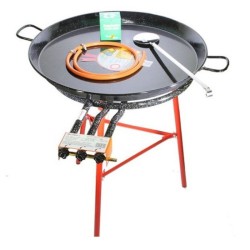
A paella burner and pan kit is a catering set ready for cooking Valencian paella over a gas flame, with every element sized to match the others to avoid the most common problem when you build the equipment piece by piece: the burner not fitting the diameter of the paella pan, so the rice cooks badly around the edges. The kits we sell at Hiperchef are made by Garcima (Valencia), the Valencian benchmark brand for paella pans and burners.
A standard kit includes a gas paella burner with concentric rings matched to the diameter of the paella pan, a paella pan in polished or enamelled steel depending on the model, a tripod stand with adjustable legs, a paddle in wood or stainless steel for stirring without scratching, and a gas kit with an approved hose and a pressure regulator to connect to a butane or propane cylinder. The whole set is certified under standard UNE-EN 16129 on pressure regulators for liquefied petroleum gases for domestic use and UNE-EN 16436 on flexible hoses for gases.
What each kit includes exactly
So there are no surprises when your order arrives, all our kits come with the following 5 items:
- Gas paella burner in cast iron or painted steel sheet, with one or several concentric rings depending on the diameter. The usable burning surface is matched to the inner diameter of the paella pan included.
- Paella pan with reinforced handles, a flat base to distribute the heat evenly and a diameter matching the burning area of the burner.
- Tripod stand with three legs and an approximate height of 20-25 cm to hold the burner at a comfortable working height (cooking while standing). Some models feature adjustable height.
- Paddle in beech wood or stainless steel with a long handle (35-40 cm) for stirring the sofrito without bringing your hand close to the heat.
- Gas kit: an approved 1.5 m hose + 30 mbar pressure regulator compatible with a standard butane/propane cylinder (orange 12.5 kg cylinder). Some kits also include a spare hose and clips.
Which kit size to buy according to the number of diners
The golden rule of paella is the rice must sit in a thin layer, never more than 1.5 cm deep, so the socarrat forms without the grains becoming stodgy. That's why sizing it correctly means choosing the paella pan diameter according to the number of diners, with the burner diameter then determined by the pan.
| Burner diameter | Pan diameter | Diners | Raw rice | Typical use |
|---|---|---|---|---|
| 30 cm | 38 cm | 4 people | 400 g | Small family, weekend |
| 30 cm | 46 cm | 6 people | 600 g | Family + guests |
| 40 cm | 50 cm | 10 people | 1 kg | Meal at a country house, large terrace |
| 40 cm | 65 cm | 14 people | 1.4 kg | Family celebration |
| 50 cm | 60 cm | 16 people | 1.6 kg | Birthdays, communions |
| 50 cm | 70 cm | 20 people | 2 kg | Small wedding, neighbourhood party |
| 60 cm | 70 cm | 22 people | 2.2 kg | Residents' association |
| 60 cm | 80 cm | 28 people | 2.8 kg | Small village fête |
| 70 cm | 80 cm | 30 people | 3 kg | Large birthday, event |
| 70 cm | 90 cm | 40 people | 4 kg | Club, social group, town festival |
For more than 40 diners you need to move up to giant paella pans with double-ring burners (80 cm+) and, usually, two independent burners. Those configurations are built to order: get in touch before ordering if you need more than 40 servings.
Gourmet range (flat burner) vs. Classic range (ring burner)
Garcima makes two clearly distinct ranges of burners that substantially change the result of the rice.
| Feature | Gourmet range (flat) | Classic range (rings) |
|---|---|---|
| Burner type | Flat, perforated | Concentric rings with raised bands |
| Heat distribution | Even across the whole surface | Concentrated in the centre, tailing off towards the edges |
| Learning curve | Easier for beginners | Requires power control so the centre doesn't burn |
| Matching pan | Polished steel | Enamelled |
| Pan maintenance | Regular seasoning with oil, dry immediately | No seasoning needed, resistant to rusting |
| Socarrat flavour | More authentic (reactive steel) | More neutral (inert enamel) |
| Relative price | Somewhat more expensive | More affordable |
| Recommended for | Those after the traditional Valencian result | Occasional use, a first burner, without wanting to season |
If you're going to make paella once a month with the family and don't want to worry about looking after the pan, the enamelled Classic range is the sensible choice. If paella is a big event at home or you're going to make it every couple of weeks, the Gourmet range with a polished steel pan will give you the result served in Valencian restaurants.
Materials: polished steel vs. enamelled paella pan
The polished steel paella pan is the original recipe for Valencian paella. The steel reacts slightly with the hot oil and the sofrito, adding a hint of flavour that enamel doesn't pass on. In exchange, you have to season it before first use (heat with oil, wait until it smokes, let it cool and clean it), and after each use you have to dry it immediately to avoid spots of rust. If it rusts on the surface, it's restored with a steel-wool ball and fresh seasoning.
The enamelled paella pan has a coating of vitrified enamel that seals the base steel. It doesn't react with food (it adds no extra flavour, but nor does it rust), needs no seasoning, is cleaned with soap and water and is dishwasher safe. The trade-off is that the enamel can chip if the pan takes a sharp knock, leaving an unprotected spot that will rust the steel underneath. For occasional domestic use — which is the case for 90% of kit buyers — it's the more practical option.
Installation, gas connection and safe use
Before using the kit for the first time it is essential to check three things. (1) Hose and regulator with an approval label and a manufacturing date less than 5 years old: although the kits leave the factory with a new hose, Spanish regulations require it to be replaced every 5 years from the date printed on the hose itself. (2) Clips correctly tightened at both ends: the connection to the cylinder and to the burner must be free of play. Test with soapy water and open the valve without lighting it: if bubbles appear at any point, there is a leak and you must not light it until it's resolved. (3) Always cook outdoors or in a room with natural ventilation: never use the gas paella burner in an enclosed indoor space because of the risk of carbon monoxide.
The tripod stand must be placed on a firm, level surface (measure with a spirit level if in doubt). Place the burner centred on the tripod, and the pan centred on the burner. Light one of the outer rings with a long lighter or a long match (never put your hand near the burner) and, once lit, open the rest. For a good paella, heat the oil over a medium flame (not full blast), fry the sofrito in the centre, spread the sofrito across the whole surface, add the stock and, from minute 5, turn up to a high flame so it evaporates.
Garcima: the Valencian benchmark brand
Garcima manufactures in Valencia. It is the reference brand for paella burners and pans in Spain, present in restaurants, hotels and homes throughout the Valencian Community and the rest of the country. The kits we sell at Hiperchef are genuine Garcima, with a 3-year guarantee against manufacturing defects.
How to choose the ideal kit
- Set the maximum number of diners: is it a once-a-year birthday paella or a regular weekend? If in doubt, choose one size up from usual: a larger pan can always take less rice, but not the other way round.
- Gourmet or Classic range: practical aspects (seasoning, washing, enamel) over gourmet ones if paella is occasional; the other way round if paella is central to your cooking.
- Where you're going to cook it: on an open terrace or garden, any kit. In a covered but ventilated villa porch or garage, prioritise the tripod height (better 25 cm than 20 cm so you don't have to stoop) and a flat burner (it concentrates less smoke).
- Type of gas: by default, a butane cylinder. If you have a fixed piped-propane installation, make sure the included regulator is compatible (some kits let you change the regulator at no cost).
- Storage: if you're short on space, choose a folding tripod stand. The large pan doesn't fold: an 80 cm kit needs 90 cm free in the cupboard.
Related categories
If you only need to replace one piece, you'll be interested in the individual categories: paella pans on their own (polished and enamelled steel, all diameters), individual gas paella burners and barbecues and paella burners as an overview of the parent category. If you're going to use it on an induction hob instead of gas, first check our complete guide to induction-suitable cookware because the traditional paella pan doesn't sit well on the induction glass.
Frequently asked questions about paella burner and pan kits
What size paella pan do I need for 10 people?
For 10 diners you need a 50 cm diameter paella pan with a 40 cm burner. This combination lets you spread 1 kg of raw rice in a layer roughly 1 cm deep, which is the optimum thickness for the grain to absorb the stock evenly and form the socarrat characteristic of Valencian paella without becoming stodgy.
Does the kit include the gas cylinder?
No. Under transport regulations, the kits leave the factory without gas. The cylinder is bought separately at any authorised Repsol Butano, Cepsa or local distributor point. A kit includes the approved 1.5 m hose and the regulator, which is all you need to connect to the cylinder you already have or buy.
Can the gas paella burner be used on an induction hob?
No. The gas burner works with a flame: it needs to be connected to a butane or propane cylinder and is lit with a lighter or match. For induction you need a paella pan specifically certified for induction hobs (with a machined flat base and a ferromagnetic bottom). In our paella pans category you'll find induction models identified with the corresponding icon.
How long does a paella burner and pan kit last?
The burner and the tripod stand last practically the user's whole life with basic maintenance (cleaning off residue after each use, storing dry and under cover). A well-seasoned polished steel pan that is dried immediately can last 20+ years. The enamelled one is limited by wear of the enamel (5-15 years depending on use). The gas hose must be replaced every 5 years under safety regulations, regardless of its appearance.
How do I season the polished steel paella pan for the first time?
Wash the new pan with hot water and a little soap to remove the factory protective film, and dry it well. Place it on the lit burner over a medium flame and pour in 100-150 ml of olive oil. Wait until the oil starts to smoke slightly — not to give off heavy smoke — and move it around with the paddle so it covers the whole surface, including the sides. Turn off the heat, let it cool, drain off the excess oil and wipe with kitchen roll. The pan will be left with a dark tone: that is the seasoning that protects the steel. Repeat the process every 5-10 uses to maintain the protection.
Do the hose and regulator work for butane and propane?
The standard regulator included with the kit is 30 mbar, compatible with domestic butane (orange cylinder, 12.5 kg) and propane (grey cylinder, 11 kg). The hose is approved for both gases. If your installation is high-pressure piped propane (industry, restaurants with an external tank), you'll need a specific 50 mbar regulator and a different hose: ask us before ordering the kit.
Can I cook fideuá or baked rice in these paella pans?
Yes. The Valencian paella pan is suitable for any dry rice dish over a flame (paella, arroz a banda, arroz negro, fideuá) and for baked rice if the pan fits in your oven. The enamelled range takes the oven up to 250 °C without any problem; the polished steel range does too, but the dry heat of the oven can speed up the loss of the seasoning, so after an oven use it's worth re-seasoning before the next paella.
Related posts
