Food dehydrators
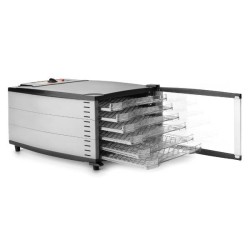

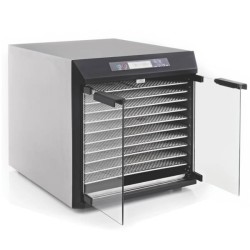

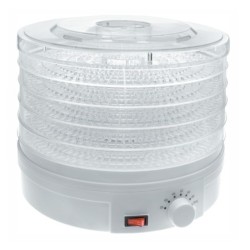
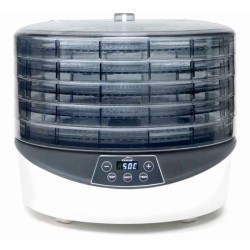
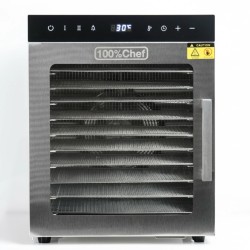
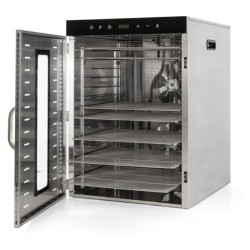
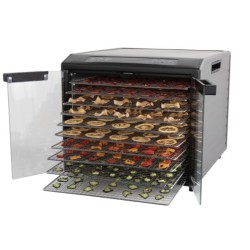
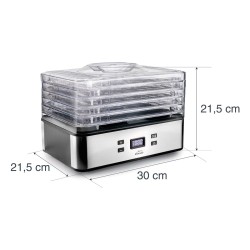
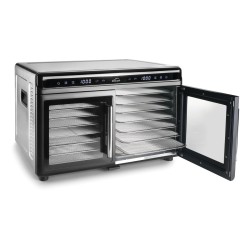
A food dehydrator draws the water out of fruit, vegetables, mushrooms, herbs, meat and fish using warm air at low temperature —always below 70 °C on domestic models— so that they keep for months without losing nutrients or flavour and without preservatives. This category runs from compact Lacor dehydrators with 5 trays and 240 W right through to professional stainless steel units with 10, 15 or 16 trays, two programmable temperatures and timers of up to 72 or 99 hours, from Excalibur and 100%Chef.
Domestic food dehydrators
The Lacor Brysa dehydrator (ref. 69522) is the compact entry-level model: 5 stackable plastic trays, 240 W, a 35 to 70 °C range and a timer of up to 72 hours in a body measuring 29.9 × 21.3 × 21.9 cm and weighing just 2 kg, with CE certification. It is more than enough for fruit crisps, vegetables, aromatic herbs and home-made cured beef.
The Lacor 69123 food dehydrator steps up to 13.5 litres of capacity spread over 6 trays, with a power selector to match the temperature to each food and very low running costs. The Lacor Terra 69223 rotating dehydrator adds an automatic 360º rotation system —3D heating— that circulates the air evenly through the holes in its 5 removable trays; it takes large pieces, makes yoghurt and comes with accessories for drying sauces and making biscuits, along with the Mi taller de Bienestar recipe book by Lauri Bengochea.
Professional stainless steel dehydrators
The Lacor Bisecco professional dehydrator (ref. 69525) is built for catering: 16 stainless steel trays, 1,400 W, a 35 to 80 °C range and a 72-hour timer in 51.4 × 36.5 × 33.5 cm. The Lacor 69523 professional dehydrator covers the middle ground for bakeries and small kitchens.
The 100%Chef Drycook dehydrators let you programme two temperatures and two consecutive times (24 + 24 h) within a single 48-hour cycle, accurate to 5 degrees between 35 and 80 °C: high at the start, when the product still holds a lot of water, then lower afterwards so the texture is not spoilt. The 10-tray model is fitted with 30 × 28 cm stainless steel trays; the 15-tray Drycook has 40 × 38 cm trays, with an interior light, a glass door for checking the product without opening it, a digital timer, optional Teflon sheets and siliconised racks, and a stackable chassis on castors.
The Excalibur Pro EXC10EL dehydrator has a double-skinned insulated stainless steel body and 10 stainless steel mesh trays adding up to a little over 1.20 m² of drying surface; its patented Parallex horizontal airflow system, digital control with LCD display, two-temperature cycles and up to 99 programmable hours make it the benchmark for continuous production. The 10-tray Excalibur EE is the version with side-mounted ceramic heating elements and a protected fan spiral, metal chassis, insulated surface and two tempered glass doors; its ultra-fine stainless steel mesh trays take up the least possible space inside.
Dehydrating temperatures by food type
These are the reference values published by Lacor in its drying times chart; it is worth fine-tuning them with experience, because the result depends on how thickly the food is sliced, on the ambient humidity and on the type of food.
| Food | Temperature |
|---|---|
| Aromatic herbs | 35-40 °C |
| Greens and leaves | 40 °C |
| Bread | 40-50 °C |
| Yoghurt | 45 °C |
| Vegetables | 50-55 °C |
| Fruit | 55-60 °C |
| Meat and fish | 65-70 °C |
How to choose a food dehydrator
For occasional home use, 5 or 6 plastic trays and a 35 to 70 °C thermostat are plenty, as on the Lacor Brysa or 69123. If you dehydrate every week or sell what you make, look for stainless steel, horizontal airflow and a long timer: stainless steel is easier to clean and holds no odours, horizontal airflow dries every level equally and the timer means you do not have to keep an eye on it. The two-temperature programming on the Drycook and Excalibur models is what makes the difference with delicate textures (fruit, pastry kitchens, snacks). Once dry, store the product in airtight preserving jars, in food storage containers or vacuum sealed using the vacuum sealers and the vacuum rolls and bags so it does not take up moisture again.
Frequently asked questions about food dehydrators
What temperature should I dehydrate each food at?
According to Lacor's reference chart: herbs 35-40 °C, green leaves 40 °C, bread 40-50 °C, yoghurt 45 °C, vegetables 50-55 °C, fruit 55-60 °C and meat or fish 65-70 °C. Lacor's domestic dehydrators always work below 70 °C; the professional Drycook and Bisecco models reach 80 °C.
How many trays do I need?
5 or 6 trays will cover a household: that is what you get on the Brysa (5 trays), the Terra 69223 (5 removable trays) and the Lacor 69123 (6 trays, 13.5 litres). From 10 trays upwards you are into professional territory —Drycook 10 and 15, Excalibur Pro and 10-tray EE, 16-tray Bisecco— with drying surfaces of more than 1 m².
Plastic trays or stainless steel trays?
Plastic trays are lighter and cheaper and are fine for home use. The stainless steel trays on the professional models stand up to heavy use, do not absorb odours, are easy to clean and take heavier loads; the 10-tray Drycook has 30 × 28 cm trays and the 15-tray model 40 × 38 cm ones.
What is horizontal airflow and why does it matter?
In a horizontal airflow dehydrator the fan sits at the back or the side and pushes the air parallel to the trays, so they all get the same flow and there is no need to rotate them halfway through. It is Excalibur's patented Parallex system and the one fitted to the 100%Chef Drycook models. Vertical airflow models, such as the Lacor Terra, make up for it with automatic 360º rotation.
How long does fruit take to dehydrate?
It depends on how thickly it is sliced, on the humidity outside and on the food itself, which is why manufacturers give reference charts rather than fixed times. That is exactly why the timer matters: 72 hours on the Lacor Brysa and Bisecco, 48-hour cycles (24 + 24) on the Drycook models and up to 99 programmable hours on the Excalibur Pro EXC10EL.
Can you make yoghurt or cured beef in a dehydrator?
Yes. Yoghurt sets at around 45 °C and the Lacor Terra 69223 includes that function along with accessories for drying sauces and making biscuits. For cured beef, jerky and dried fish you work at 65-70 °C, the top end of the chart.
How do you store dehydrated food?
Dry, airtight and away from the light. Airtight preserving jars are the usual choice at home; for production or for months of storage, vacuum sealing with a vacuum sealer and vacuum bags stops the product taking up moisture again.