Bread proving baskets



Bannetons: rattan proving baskets for bread
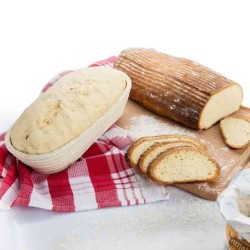
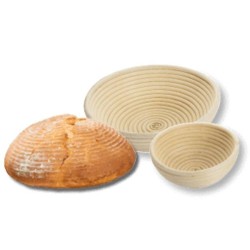
A banneton is a natural rattan basket in which bread dough goes through its second prove: it supports the loaf as it rises, gives it its final shape and leaves the characteristic spiral marked on the crust. At Hiperchef you'll find bannetons that are round, oval, rectangular, baguette, crown and heart-shaped, in sizes from Ø17.5 to Ø28 cm and from 22 to 44 cm long, with or without a cotton liner, from Ibili and Westmark.
The benefit is not only a visual one. Rattan absorbs part of the surface moisture from the dough while it proves, so the bread does not sweat or stick, goes into the oven with a slightly drier skin and develops a better crust and scoring. It is the basket artisan bakers use for long fermentations, including slow cold proves in the fridge, and it is indispensable with very wet doughs or sourdough, which would spread out flat without support.
Bannetons without a liner, in bare rattan
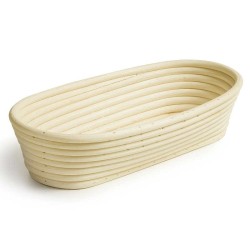
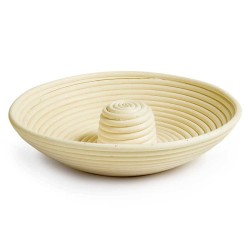
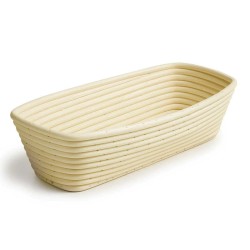
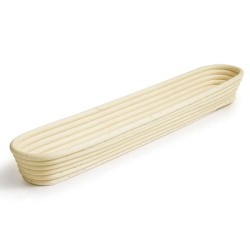
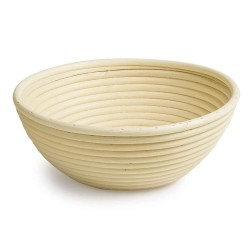
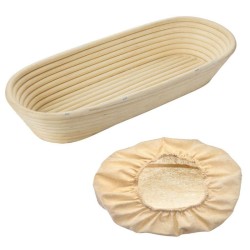
These are the classics and the ones that mark the spiral most clearly. The Ibili baskets, from the Moldes Artesanales collection, cover every usual shape: the round banneton bread proving basket is made in Ø22 and Ø25 cm with a height of 8.5 cm, the oval banneton bread proving basket measures 27 x 13 cm and stands 6.5 cm high, the rectangular banneton bread proving basket 29 x 15 cm with a height of 8 cm, the crown banneton bread proving basket Ø28 x 8 cm for ring loaves with a hole in the middle and the baguette-shaped banneton bread proving basket 44 x 10 cm with a height of 5.5 cm, for long sticks.
From Westmark you have the Westmark round rattan banneton in two sizes, Ø18 x 8 cm and Ø25 x 8.5 cm, and the Westmark oval rattan banneton in 28 x 13 cm and 40 x 15 cm, both 6.5 cm high. None of these baskets is dishwasher-safe or oven-safe: they are proving baskets, not baking tins.
Bannetons with a cotton liner
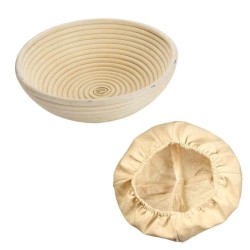
A 100% cotton liner is the best ally of very wet doughs: it lines the basket, stops the dough gripping the rattan and leaves a smoother crust; take it out and you get the marked spiral back. It also covers the loaf while it proves so it does not dry out or form a skin. The models with a liner come with the match between size and dough weight already worked out, which is the figure that really matters when you choose:
- Round banneton proving basket with liner: Ø175 x 81 mm for 750-1,000 g of dough, Ø205 x 81 mm for 1,000-1,500 g and Ø245 x 85 mm for 1,500-2,000 g.
- Oval banneton proving basket with liner: 275 x 140 x 71 mm for 750-1,000 g and 395 x 154 x 72 mm for 1,500-2,000 g.
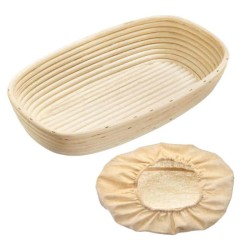
- Rectangular banneton with liner for dough proving by Westmark, 335 x 205 x 80 mm, for the traditional long sandwich loaf.
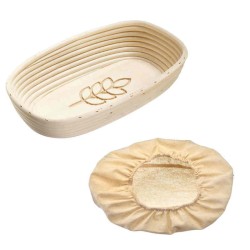
- Rectangular banneton proving basket with wheat pattern and liner, 340 x 205 x 80 mm, which prints the wheat-ear motif on the surface.
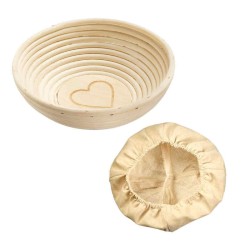
- Round banneton proving basket with heart pattern and liner, Ø245 x 85 mm, and the heart-shaped banneton proving basket with liner, 220 x 235 x 65 mm, for gift loaves and special occasions.
All of them are made from 100% odourless natural rattan, are cleaned by hand by shaking or brushing out the flour and, thanks to their natural finish, double up afterwards as a bread basket on the table.
How to use a banneton, step by step
Flour the basket well before the dough goes in: that is the step that decides whether the loaf turns out cleanly or sticks. Dust generously and reach right up the sides; many bakers use rice flour or a mix with semolina because they absorb less moisture than wheat flour. Put the shaped dough in seam side up, cover it with the liner or a cloth and let it prove for as long as your recipe asks, at room temperature or in the fridge. Once it has reached the volume you want, turn the banneton out with one sharp movement onto the peel or the baking stone, score it with a lame and bake.
How to clean and season a banneton
Rattan is never washed with soap and never soaked: simply turn the basket upside down, tap it gently so the flour falls out and brush off the dry residue with a dry brush. Leave it to air-dry completely before you put it away, because trapped moisture is the one thing that can make it go mouldy. Cotton liners can be hand-washed in warm water. With use, the basket seasons itself: the flour left in the weave forms a natural non-stick layer and it sticks less every time. And one rule that admits no exceptions: a banneton never goes in the oven or the dishwasher.
How to choose your banneton
Choose by dough weight, not by looks: a 1 kg loaf calls for a round basket of Ø20-22 cm or an oval one of around 28 cm; if you make large loaves of 1.5 to 2 kg you need the Ø25 cm or the 40 cm oval. Then decide the shape according to how you bake: round for a boule, oval for a bâtard, baguette if you have a perforated tray, crown for ring loaves and rectangular if you want an even slice for toast. And finally, with a liner if you work at high hydrations or with sourdough, without one if you want the spiral clearly marked.
To complete your baking kit you have rolling pins, baking utensils and the rest of the baking tins and moulds; if you want to learn the technique properly, take a look at the bread baking books.
Frequently asked questions about bannetons
What exactly is a banneton for?
It's for the second prove of the bread: it supports the dough as it rises, gives it its final shape and absorbs surface moisture, so the loaf doesn't sweat or stick and goes into the oven with a better skin. It also leaves the rattan spiral marked on the crust.
What size of banneton do I need for 1 kg of dough?
A round basket of around Ø20-22 cm or an oval one of 27-28 cm. As a guide, the models with a liner state their capacity: Ø175 mm takes 750 to 1,000 g of dough, Ø205 mm 1,000 to 1,500 g and Ø245 mm 1,500 to 2,000 g; in oval, 275 mm for 750-1,000 g and 395 mm for 1,500-2,000 g.
Do I need to flour the banneton, and with which flour?
Yes, always, and generously. Rice flour or a mix with semolina works better than wheat flour because it absorbs less moisture and forms a more stable non-stick layer, especially with wet doughs or sourdough.
Can the banneton go in the oven?
No. Neither the oven nor the dishwasher. It's a proving basket: the dough is turned out onto the stone, the tray or the peel and baked outside the basket.
How do you clean a rattan banneton?
Dry. Tap it upside down so the flour falls out and brush off whatever is left, with no soap and without soaking it; then leave it to air-dry completely. The cotton liner can be hand-washed in warm water.
What's the difference between a banneton with a liner and one without?
Bare rattan marks the spiral on the crust and is the bakery classic. The cotton liner stops very wet doughs sticking and gives a smoother surface; as the liner is removable, one basket lets you choose the finish you want for each bake.