Sous vide cooking
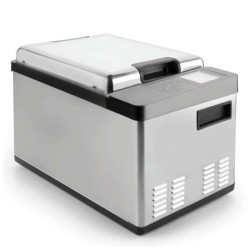

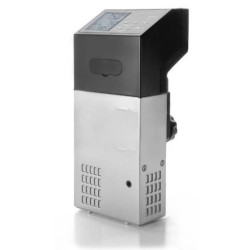


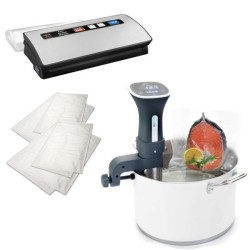
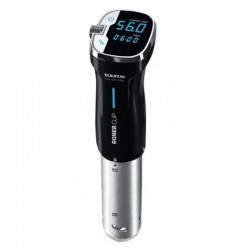
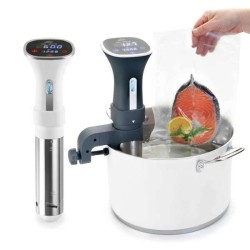

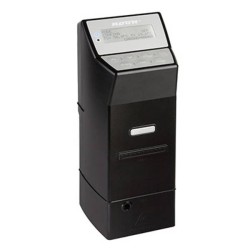
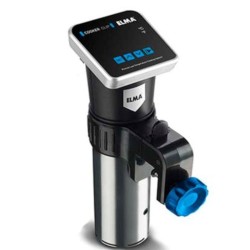
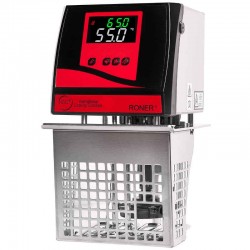
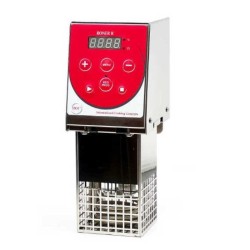
Low-temperature cooking, also known as sous vide, has established itself as one of the essential techniques in both professional kitchens and demanding homes. Its success comes down to three reasons: precise, reproducible cooking results, the intact preservation of juices and nutrients, and the growing availability of equipment at affordable prices. Roner is the long-standing brand that gave its name generically to the appliance —as happened in the past with Donuts, Danone or Chupa-Chups—; manufacturers refer to it by various terms: Sous Vide, thermal circulator, low-temperature cooker, precision thermal bath, and so on.
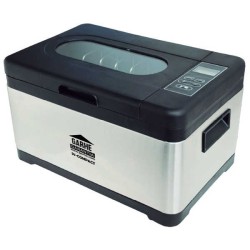
Which type of Roner or Sous Vide should you choose? On the market you'll find two types: the stick or portable ones such as the Roner Clip by Taurus, or those with an integrated tank such as the SV-Compact by Garhe. The latter tend to be more reliable in the long run than the stick models; however, they take up more storage space and have a limited usable cooking capacity. This is why the best-sellers by far are the portable or stick versions.
How much quality do I need? Here more than ever the price of the sous vide is closely linked to its quality, as is the use I'm going to give it to the money I should spend. Similar cooking results can be obtained with the most economical models; however, the cheaper models don't have the same strength and durability, and you also have to bear in mind that some of the most economical models have no replacement parts. So for regular professional use, we always recommend buying the ICC Roners themselves, the Noon thermal bath-type Sous Vide units, or the Sammic SmartVide. For occasional professional use, the Noon thermal bath is also a good choice, but in no case a model cheaper than the Lacor 69192 Sous Vide. At domestic level it's also important to know how often it will be used in order to make the right choice, one of the best being the Roner Clip by Taurus.
What maintenance do they need? Sous Vide units are one of the appliances we sell that suffer most with use. Being in contact with evaporating hot water, the minerals the water contains —such as limescale— gradually build up on them; these minerals can slow down or even block parts such as the impeller, burning out the control board, cause the heater to fail, or affect the thermometer that controls the thermostat. We also often subject them to large temperature changes, which puts strain on the seals of the dry zone and makes them fail, letting moisture into the control boards with the consequent result. This is why it's very important to carry out limescale cleaning when due; even if you have softened water you'll still need to do it, though less often, as well as avoiding sudden temperature changes and, of course, following the manufacturer's manual recommendations.
Another way we can look after these appliances for low-temperature or sous vide cooking is to use suitable containers — within the maximum capacity indicated by each manufacturer, of course, as well as in terms of their materials. For example, if we use the Sous Vide with a metal pot on top of a marble worktop, the heat transfer generated by the device will be much greater than if we work with a fully insulated tank, so the machine has to work harder, heating the water more often.
Frequently asked questions about roner and sous vide
What is a roner or sous vide and what is it for?
A roner or sous vide is a thermal circulator that keeps the water at an exact, constant temperature for hours. It lets you cook sous vide (the food is packed in sealed bags) at a low temperature, preserving juices, textures and nutrients. It's the preferred technique for very tender meats, perfectly cooked fish and al dente vegetables with no loss of flavour.
What is the difference between a clip-on roner and a thermostatic bath?
The clip-on roner (such as the Roner Clip by Taurus or Anova) attaches to the edge of any container and heats the water by circulating it; it's compact, portable and affordable. The thermostatic bath (such as the Sammic SmartVide or ICC) is an enclosed tank with a heating element, a larger fixed capacity and insulation; it withstands intensive professional service. For home or occasional catering, a clip-on is enough; for a restaurant with daily production, a professional bath is the way to go.
Which sous vide roner should you choose for each use?
For intensive professional use: ICC Roners, Noon thermal baths or the Sammic SmartVide. For occasional professional use, the Noon bath is also a good choice, but never a model cheaper than the Lacor 69192 Sous Vide. For home use, one of the best is the Roner Clip by Taurus for its price-to-performance ratio. The most important thing is to match the model to how often it will really be used.
At what temperature do you cook sous vide?
The usual temperatures are: delicate fish 50-55 °C, salmon cooked medium 50 °C, tuna 45 °C, poached egg 63 °C, chicken 65 °C, beef medium 56-58 °C, pork 60-62 °C, ribs and oxtail 70-75 °C for 24-36 h, vegetables 85 °C. Each recipe requires adjusting time and temperature: a fillet steak is done in 1 h at 56 °C, a pork shoulder needs 24 h at 70 °C.
What maintenance does a sous vide roner need?
Sous vide units are devices that suffer greatly with use. Limescale from the water can slow the impeller, burn out the control board or damage the thermostat. It's essential to descale every 50-100 hours of use (more often in hard-water areas), to avoid sudden temperature changes and to follow the manufacturer's manual. If you have a water softener at home, descaling can be spaced out, but not eliminated.
What bags and vacuum sealer do you need for sous vide?
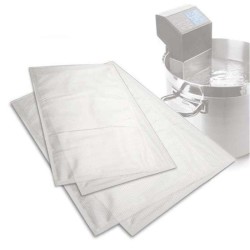
You need bags made specifically for vacuum sealing and cooking (not the shop-bought freezer ones), suitable for temperatures of up to 100 °C, and a vacuum sealer that seals airtight. For home use or light catering, an external-suction Lacor or Sammic vacuum sealer is enough; for serious production, a professional chamber vacuum sealer. At Hiperchef we have vacuum sealers and bags certified for sous vide.