Dynamic: the story of the European brand that invented the professional stick blender
Dynamic is not a household-appliance brand. It is a European manufacturer of industrial kitchen tools, with a single plant in France and a very specific philosophy: to build machines that withstand thousands of hours of heavy-duty use and that, when something fails, are repaired rather than thrown away. This article explains what lies behind that promise —materials, production process, repairability commitments— and why a Dynamic behaves differently from a domestic appliance dressed up as professional.
A European brand with manufacturing concentrated in France
Dynamic is manufactured at its European industrial plant in France. There, the Société d'études et réalisations mécaniques dite DYNAMIC brings all its activity together under one roof: design, injection moulding of plastic parts, motor winding, assembly, quality control and after-sales service. The company belongs to the Groupe Nadia, a family-owned industrial group, and exports approximately 85% of its production to more than 120 countries.
“At Dynamic, the design of robust, durable and repairable products has been part of our DNA since 1964.”
— Official Dynamic catalogue, professional edition 2026
That sentence, repeated page after page in the catalogue, is not an advertising slogan: it is the direct consequence of how the factory is organised, how the materials are chosen and how the after-sales service is structured.
Sixty years building machines to last
Dynamic was founded in 1964 as a mechanical studies and engineering company, initially devoted to citrus juicers. Two years later, in 1966, it took the step that would define its entire history: it invented the professional stick blender in France, able to work in pots of tens or hundreds of litres, with a stainless steel shaft, a reinforced motor and, above all, detachable so it could be cleaned and repaired without destroying it. (The physical principle of the immersion blender had previously been patented by the Swiss inventor Roger Perrinjaquet in 1950, but for domestic use; the professional version was born in the brand's European workshop.) That original decision (a body you can open by hand) is the seed of the entire present-day philosophy. Along the way come milestones such as European expansion in the 1970s, joining the Groupe Nadia in the 1980s, the Gigamix turbo mixer (2009), the first cordless professional stick blender, the Dynamix Nomad (2016) and, in 2021, the consolidation of all production at the current European plant. Sixty years on, the craft remains the same.
Quality philosophy: an industrial tool, not a household appliance
The difference between a Dynamic and a consumer blender lies in the invisible decisions: which steel is used in the shaft, how the motors are wound, which silicone goes into the seals, how the joints are sealed against steam and cleaning baths. Dynamic makes equipment designed for professional kitchens where the work cycle is demanding, temperatures are high and HACCP hygiene protocols are mandatory.
Materials chosen as if they were meant to last for decades. The blending shaft, the bell and the blades are built in food-grade stainless steel; on the MD95+, for example, the blades carry a titanium coating that, according to the manufacturer, optimises the durability of the cutting edge under heavy use. The motor body combines silumin (an aluminium and silicon alloy) for the structural parts with technical-grade plastic housings, and the seals in contact with food are made of food-grade silicone suitable for daily cleaning cycles.
Motors wound in-house. Dynamic designs and winds its own electric motors inside its European industrial plant. This lets it fine-tune the torque-power-consumption ratio of each range (250 W on the MD95+, 350 W on the Senior, 600 W on the Master, 850 W on the SMX, 1.5 to 2.2 kW on the Gigamix) and, above all, guarantee that those windings will keep being made exactly the same for years. A motor bought from any random Asian supplier can disappear from one year to the next; a motor wound in-house keeps being made as long as there is copper wire and lamination.
Reinforced sealing and electrical protection. The ranges are designed to live with splashes, steam and intensive washing cycles: the long shafts of the Senior, Master and SMX integrate solid stainless steel bells and tubes with seals that isolate the motor body from the liquid, and the electrical units feature a safety button to prevent accidental start-ups during cleaning.
Audited European suppliers. The external components Dynamic does not manufacture (fasteners, electronics, bearings) come mostly from European industrial suppliers. This translates into CE conformity, the RoHS directive, the WEEE system and specific certifications (IEC, UL and NSF for North America, ERL for certain markets). These are not decorative marks: they are the condition for a hospital, a contract caterer or a hotel chain to accept the equipment in its purchasing specification.
European manufacturing: the whole cycle under one roof
The word “European” only has value when it translates into real product traceability. At Dynamic, that traceability takes shape in a single industrial plant in France. Since 2021, the brand has consolidated all production at that European centre, so that today the complete cycle of a machine takes place within the same industrial site:
Design with an explicit eco-design criterion: each new product is conceived with dismantling and the future availability of spare parts in mind.
Injection moulding of parts in plastic, using technical resins suitable for food contact.
Motor winding in an in-house workshop, with full control over power, working temperature and part continuity.
Assembly of the motor body, stainless steel shaft, bell, blade, wiring and safety electronics, with accessible fasteners, never with destructive welds.
Quality control in an in-house laboratory: start-up, consumption, temperature, watertightness and operation of the safety button.
After-sales service and spare-parts warehouse in the same complex, a few metres from the assembly line.
This concentration has three practical consequences: traceability (each machine is delivered with a manual and guarantee that accompany it throughout its service life), a short chain (a spare part can arrive in days, not weeks) and European regulatory compliance by design: the CE, RoHS and WEEE standards are not a final seal but conditions built in from minute zero. The fact that Dynamic keeps its own subsidiary in Germany and in North America, two of the world's most demanding markets for electrical certification and food hygiene, ends up raising the bar for the rest of the catalogue.
Machines built to last: robustness sized for continuous shifts
Announcing durability is one thing; designing for it is another. In the Dynamic ranges there are several engineering decisions that explain why the same machine is still running five or ten years later, while other similarly priced equipment gives up after two years.
Motors sized above the real load. In an institutional kitchen, a blender works in back-to-back batches all morning long. Dynamic motors are chosen with a power margin that lets them cope with that regime without overheating: the 600 W of the Master would be more than enough to empty a 40 L pot, but they are exactly what is needed to repeat the task every day for a decade. The Gigamix, at 1.5 to 2.2 kW, is designed directly for vats of 40 to 500 L in continuous production.
Oversized couplings and shafts. On the long blenders, the join between the motor body and the blending shaft is the most punished point: it has to transmit torque over several hundred millimetres inside hot liquid. The Senior, Master and SMX series use reinforced couplings and stainless steel shafts able to absorb that stress without developing play after thousands of hours of work.
“All-stainless” construction in the critical areas. The formula “stainless steel shaft, all-stainless tube and bell for easy maintenance” is repeated on almost every page of the catalogue. It is not only hygiene: it is the guarantee that the machine withstands hot water, disinfectants and repeated cycles without the surfaces rusting. In a professional environment, hygiene and durability are the same technical problem.
No cosmetic parts. Opening a Dynamic machine and comparing it with a consumer appliance makes the difference clear: there are no decorative parts, no single-use clips, no glued housings that force you to throw away the whole unit when one small detail breaks. Everything you see performs a mechanical, electrical or hygienic function.
A concrete example: in an institutional canteen, the Senior or the Master handles soups, purées, base sauces and blended vegetables shift after shift; the operator dismantles it every night to wash it, it goes through the industrial dishwasher and it starts up again at 7:00 with the first pot. That pattern of dozens of cycles a week with steam, hot water and alkaline detergent is exactly the scenario the machine was drawn for.
Repairability: ten years of guaranteed spare parts worldwide
If there is one trait that sets Dynamic apart from most competitors, it is its public commitment to repairability. The 2026 catalogue puts it bluntly:
“Our products are designed to be easily repairable, dismantled and reassembled. DYNAMIC undertakes that its products will be repairable for 10 years in France and worldwide, guaranteeing the immediate availability of spare parts.”
— Dynamic professional catalogue 2026, p. 8
Ten years. Translated into the day-to-day of the caterer: if a chef buys a Master MX 91-500 today, Dynamic undertakes that, in 2036, they will still be able to find the blade, the oil seal, the bell, the bearing, the switch, the cable or the tube they need for that machine. And not only that: the machine is designed so that this part can be changed without destroying the rest of the motor body.
Modular design. The blending shafts are mounted with clamping systems designed to be dismantled without tools on models such as the Dynamix, or with reinforced, accessible anchors on the Senior, Master and SMX. The blades separate from the shaft with a simple movement; a chef can change a chipped blade in their own kitchen. The bells are independent, replaceable parts. The switches, speed controllers, cables and electronics are conceived as sub-assemblies, not as encapsulated boards: an authorised service centre replaces them without sending the machine back to the European factory. The motor block allows complete dismantling: rotor, stator, bearings and brushes (where applicable) are accessible. This modular architecture is accompanied by a “renovation process and rigorous inventory monitoring” that ensures fast supply to any customer in the world.
A commercial advantage over the “throwaway” approach. A low-end blender with a sealed housing and an encapsulated board is not repaired: it is replaced. When a minor component fails, repairing usually costs more than buying a new one, and the whole machine ends up in the bin. At Dynamic, the calculation is the opposite: a chef who buys a Senior today can keep it working for ten or fifteen years with occasional replacements of blade, bell or bearing. Per unit of production, a Dynamic blender written off over ten years works out cheaper than a low-cost machine replaced every eighteen or twenty-four months, with fewer unplanned stoppages and less inventory churn.
An ecological advantage: circular economy without the speeches. Every kilo of steel, copper, aluminium and plastic that does not go in the bin is one kilo less in the restaurant's footprint. The catalogue itself sums it up: “design better to consume less, repair rather than discard and incorporate more recyclable materials”. At Dynamic, repairability is not an ecological add-on; it is the skeleton of the product.
The Dynamic 2026 ranges, explained for a professional buyer
Dynamic covers practically the entire chain of blending and mixing jobs that arise in a professional kitchen, from the five-cover bistro to a hospital's central kitchen.
Small and medium stick blenders
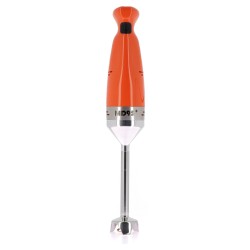
MD95+. 250 W one-piece unit, for containers from 1 to 8 L. Stainless steel blades with a titanium coating. Optional version with a temperature probe (5-115 °C) for HACCP control.
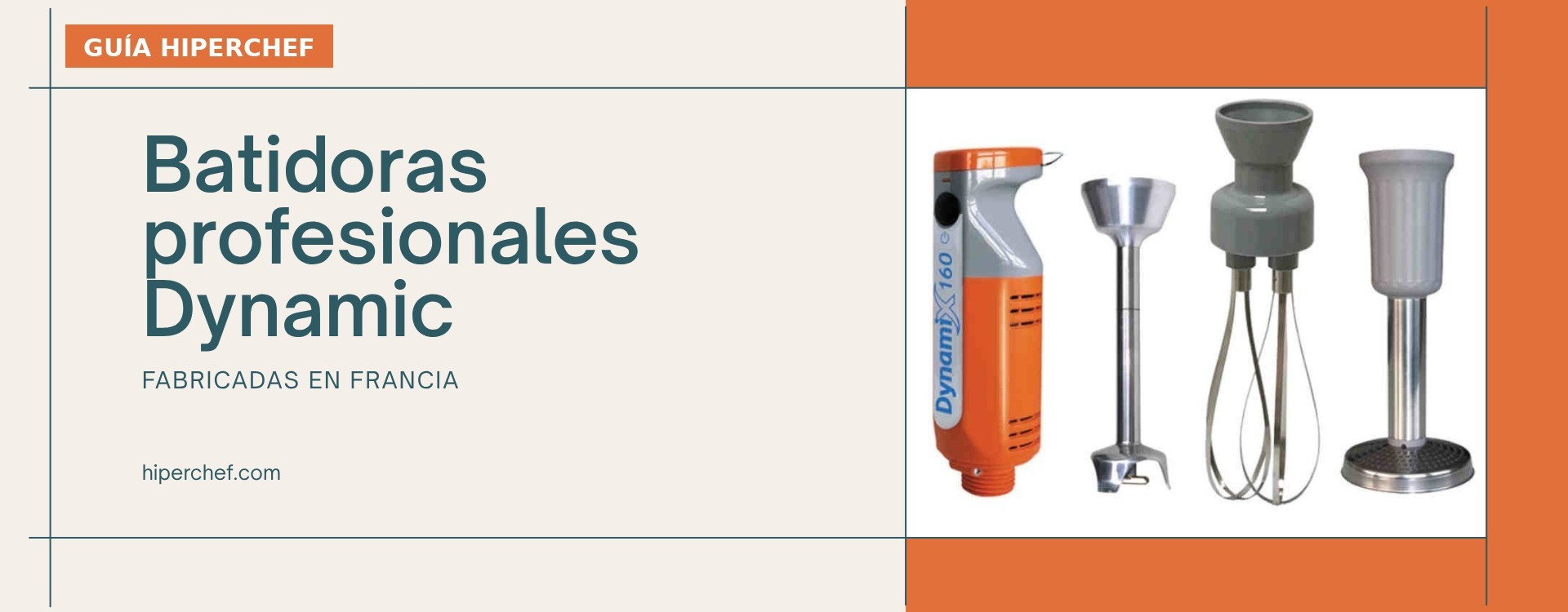
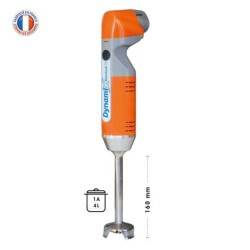
Dynamix / Dynamix V2 / Dynamix Nomad. Detachable shaft, 220-250 W, 1-8 L. The Nomad was, in 2016, the first cordless professional stick blender on the market.
Junior MX 225. 270 W, up to 25 L. The entry point to the long-tube range.
Senior MX 300. 350 W, 20-40 L. The “all-rounder” for restaurants with extensive menus.
Large stick blenders and turbo mixers
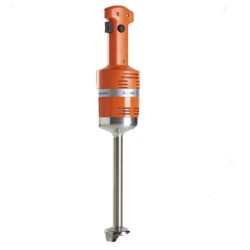
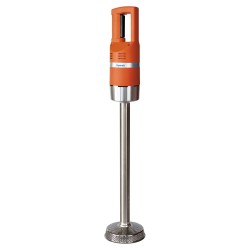
Master. 600 W, from 5 L to 100 L. MX 350, MX 410, MX 91-410 and MX 91-500 versions depending on tube length.
SMX. 850 W, 75-300 L. The “industrial” range for central kitchens, caterers and hospitals.
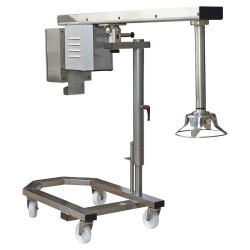
Easymix. The Master range mounted on a fixed, wall-mounted or wheeled stand, for repetitive applications.
Gigamix / Gigamix XS. Turbo mixers of 1.5 to 2.2 kW, 40-500 L, for soups, base sauces and institutional purées.
Food mills, cutters, combi units and accessories
PP 300 and PP 520 food mills. 650 W, 20-100 kg/h.
Combi, table-top cutter, Blend & Mix. 1,100 W, 5.4 L bowl. The Blend & Mix is specifically designed for texture-modified food (hospitals and care homes with dysphagia patients).
Dynacube, salad spinner, Dynajuicer, FMA. Cutting and juicing accessories. The Dynacube is, in the manufacturer's words, “the world's No. 1 manual dicer” (2026 catalogue, p. 61).
Range comparison table (quick summary)
Range
Power
Working volume
Typical application
MD95+
250 W
1-8 L
Bistros, patisserie, small kitchens
Dynamix / V2 / Nomad
220-250 W
1-8 L
Service kitchen, light catering
Junior
270 W
up to 25 L
Medium-sized restaurant
Senior
350 W
20-40 L
Large restaurant, hotel
Master
600 W
5-100 L
High-volume kitchens, caterers
SMX
850 W
75-300 L
Central kitchens, hospitals
Easymix
600-850 W
as per Master/SMX
Repetitive applications on a stand
Gigamix / Gigamix XS
1.5-2.2 kW
40-500 L
Industrial turbo blending
PP 300 / PP 520 food mill
650 W
20-100 kg/h
Electric food mill
Combi / Cutter / Blend & Mix
1,100 W
5.4 L
Cutter, emulsions, texture-modified food
International presence
Dynamic operates with its headquarters and sole industrial plant in France, a German subsidiary (Dynamic Professional GmbH, in Kehl), subsidiaries in Canada (Montreal) and the United States (Champlain, New York), Spanish distribution through GCI Brands (Sant Boi de Llobregat) and a network of importers in more than 120 countries. The direct subsidiaries in Germany and North America force the brand to submit continuously to UL and NSF certifications and to German industrial-electrical standards, which ends up raising the bar for the entire range.
Professional use cases
Traditional and bistronomy restaurants: MD95+ or Dynamix V2 for emulsified sauces, vinaigrettes, soups and mayonnaises made fresh each day.
Large-menu restaurants and hotels: Junior and Senior for mid-sized pots in the prep kitchen.
Catering and institutional catering: Master and Easymix in 50-100 L pots; the stand frees up the operator during blending.
Central kitchens and hospitals: SMX and Gigamix in 200-500 L pots, where shaft robustness and motor cooling are critical.
Care homes and dysphagia: Blend & Mix, specifically designed for texture-modified food.
Bakeries, patisseries and production kitchens: Dynacube and electric vegetable cutters for precise cutting.
Sustainability: 2024 figures that back up repairability
Dynamic's ecological message is not a marketing veneer: the very genesis of the product (dismountable machines with spare parts guaranteed for a decade) is already, structurally, a circular economy. The 2026 catalogue provides verifiable figures:
Annual carbon assessment since 2021.
2024 emissions:372 tCO₂e per million euros of turnover, compared with the 500-3,000 tCO₂e/€M average of the industrial sector (source: Statista, cited by Dynamic).
Targets aligned with the Paris Agreement: an annual reduction of 4.2% in Scopes 1 and 2 and of 2.5% in Scope 3, up to 2030.
88% of the catalogue with a complete Life Cycle Assessment (LCA).
58% of the workforce trained in 2024, with an average of 20.83 hours per person trained.
Inclusion: 2.84% of employees with a disability, partnerships with local sheltered-employment companies and 625 hours of training delivered in 2024.
For catering businesses that report on ESG, buying a Dynamic means acquiring equipment whose industrial footprint is measured, audited and published.
Why choose Dynamic
Quality philosophy. Industrial materials (stainless steel, silumin, food-grade silicone, titanium-coated blades), motors wound in-house and European regulation by design.
European manufacturing (single plant in France). Design, injection moulding, winding, assembly, quality control and after-sales service under one roof at the company's European factory.
Machines built to last. Power ratings sized for continuous shifts, reinforced couplings, “all-stainless” construction and no cosmetic parts.
10-year repairability. A written commitment to worldwide spare-parts availability, modular design and fast supply from the European plant.
Comprehensive certifications. CE, IEC, UL, NSF, ERL, RoHS and WEEE.
If a caterer is comparing quotes between a Dynamic and a generic blender, the question is not what each machine costs today, but how many work cycles will come out of every euro invested. On that calculation, the French brand has been winning for sixty years.
Frequently asked questions
Is Dynamic a European brand?
Yes, 100%. Its sole production plant is in France and the company belongs to the Groupe Nadia. The entire chain of design, injection moulding, motor winding, assembly, quality control and after-sales service is concentrated at that French production centre, under European CE, RoHS and WEEE regulation.
Why does a Dynamic last longer than a low-end blender?
Because it is designed to industrial criteria from the first sketch: food-grade stainless steel in the shaft, tube, bell and blades; motors wound in the factory itself, with power ratings sized to work continuous shifts; reinforced couplings; “all-stainless” construction suitable for intensive washing; and no sealed housings or cosmetic parts. All those details, invisible on a sales sheet, explain the difference between a machine that lasts ten years and one that gives up after two.
How many years of spare parts does Dynamic guarantee?
10 years worldwide. The brand undertakes in writing that all its products will be repairable for a decade, both in France and in any other country where they are sold, guaranteeing the immediate availability of spare parts. The modular design allows you to replace the shaft, blade, bell, switch or electronic sub-assemblies without sending the machine back to the factory.
Which range suits me according to working volume?
As a practical rule: MD95+ and Dynamix for pots of up to 8 L; Junior up to 25 L; Senior up to 40 L; Master up to 100 L; SMX up to 300 L; and Gigamix between 40 and 500 L when you need high-volume turbo blending. For the exact model it is also worth considering the depth of the pot and the daily frequency of use.
Are they suitable for texture-modified food?
Yes. The Blend & Mix range is specifically designed to prepare texture-modified menus, suitable for patients with dysphagia. It is the range chosen by hospitals, care homes and healthcare services that must guarantee a smooth, swallow-safe texture.
Where are Dynamic machines made?
At its European industrial plant in France. Since 2021 it has been the brand's sole production plant, after consolidating the historic facilities there. The complete cycle takes place at that centre: design, injection moulding, winding, assembly, quality control, spare-parts warehouse and after-sales service.
What does “tool-free dismantling” mean?
It means that the parts in contact with the food (shaft, bell and blade) separate from the motor body with a simple movement of the hand, without spanners or screwdrivers. This makes daily cleaning, HACCP compliance and quick repairs easier, without having to send the machine to a workshop. It is also the practical basis of the ten-year repairability commitment: if you cannot open it by hand, you cannot repair it quickly.
Leave a comment
Log in to post comments