- -38.02%


 Read the 2 reviews
Description
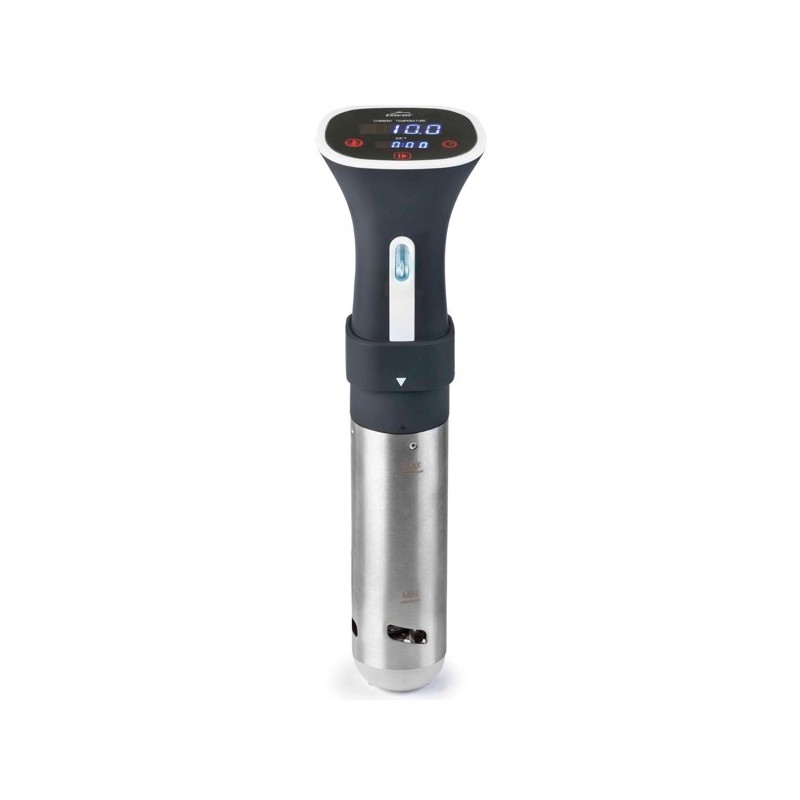
Lacor Sous Vide Gourmet low-temperature cooker. Available in black (69302) and white (69303)
It includes a comprehensive recipe book with all kinds of recipes, created by Miriam García (invitadoinvierno.com) exclusively for Lacor. With the Sous Vide Gourmet you can prepare all kinds of meat, fish, eggs, fruit and vegetables with truly remarkable results.
What is sous vide cooking?
A culinary technique that puts the quality of the ingredients first. Remarkable results: juicier, more tender and more succulent food.
It preserves the qualities of the ingredients and enhances their flavour and texture. Compact design, simple clamping, and easy to store and carry. Includes a comprehensive, exclusive recipe book.
Benefits of low-temperature cooking:
Among the new catering techniques, the most important is vacuum cooking and preservation. The advantages that this technique offers ensure it can be introduced and adapted to the needs of any kitchen: saving time, improving costs, better organisation of staff and longer shelf life for ingredients while keeping their hygienic and organoleptic qualities are some of the main reasons behind its success and adoption in catering.
We are talking about products that undergo vacuum packing and are exposed to temperatures that never exceed 100 °C. Because of the pressure difference, we achieve water boiling temperatures at a low temperature, and heat penetrates to the core of the product in a linear way; that is, it meets no air molecules and produces no radial reaction, so the treatment and the results obtained with the product are perfectly controlled.
The simplest way to explain sous vide cooking is this: instead of the traditional method of cooking food at 130 °C for a relatively short time, here it is cooked between 65 °C and 99 °C over longer times depending on the nature and weight of the ingredient. It is, therefore, long, low-temperature cooking. In a conventional oven, a piece of meat is cooked at 200 °C, which causes the outside to brown. However, the temperature at the core of the piece rarely exceeds 50 °C. A temperature equal to or slightly above 65 °C is therefore all that is needed to cook food, avoiding the drying out and toughening of the muscle fibre as well as overcooking.
Technical details

Data sheet
Specific References