- -5%
 No review at the moment
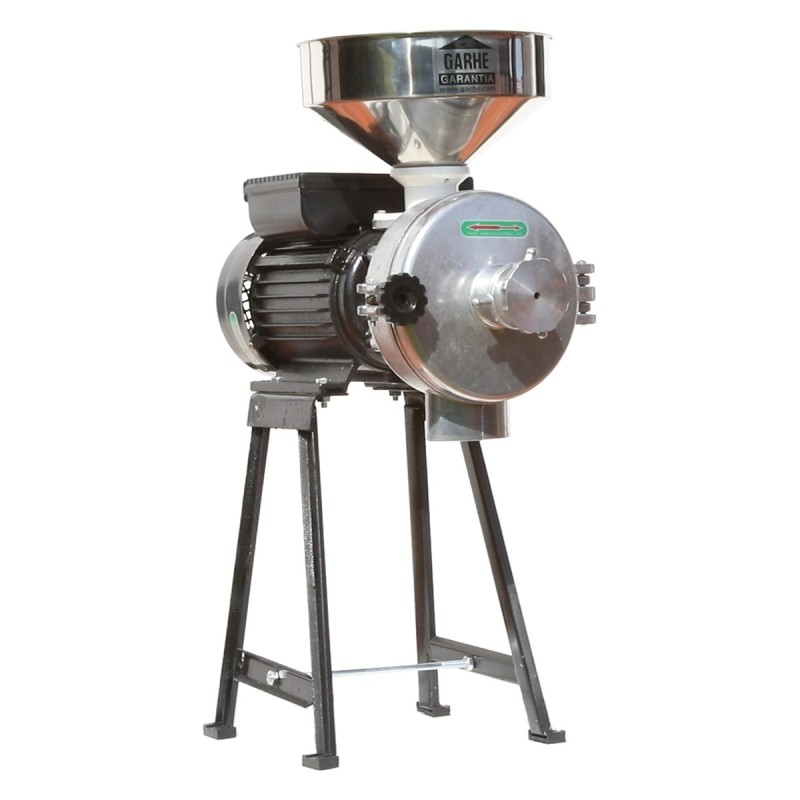
Garhe 00830 electric grain mill, 3 HP (2,200 W), with a cast aluminium body on steel legs. 150 mm friction burrs with adjustable pressure, 24 cm stainless steel hopper and single-phase motor at 1,440 rpm. It grinds cereals, pulses and nuts and is the model we recommend for crushing whole olives, stones included, to make oil.
Description
The Garhe 3 HP electric grain mill (reference 00830) is the most powerful burr mill the brand makes: a single-phase 2,200 W motor at 1,440 rpm, a cast aluminium body on steel legs and two 150 mm burrs that are tightened or loosened with a handwheel to choose how coarse the grind is. It makes flour from wheat, maize, barley or pulses, grinds nuts and, above all, crushes whole olives, stones included, to make olive oil at home. It is the mill we recommend for olives.
Garhe makes it in Berriz (Biscay) and offers it with two types of burr: steel for dry products and stone for wet or oily products. The set of stone burrs (ref. 00832), the spare steel burr (00821) and the flour collecting sleeve (00835) are available to order.
Home-made olive oil. This is the first step of the home olive press: the olives go in whole, stones included, through the hopper and come out as a paste. Garhe shows this mill crushing olives with their stones in the video on this page. With 3 HP the motor does not stall on the stones or on the oily pulp, which is where small mills jam. After grinding, the paste has to be mixed before pressing: during that mixing the small droplets of oil come together and the press gets far more oil out of the same paste. For that step we use the Garhe electric meat mixers, 20 and 40 litres, which is what lets you get the most oil out of the olives.
Cereal and pulse flour. Wheat, maize, barley, rye, oats, chickpeas or dried lentils. The texture is set by the pressure of the burrs: tighten for fine flour, loosen for semolina or cracked grain. If the first pass comes out coarse, run it through again with the burrs closer together.
Nuts and plant-based milks. Almonds, hazelnuts or walnuts are ground for nut flour or as the base for a plant-based milk. For oily pastes the stone burr set is the better choice.
Animal feed. Anyone with hens, rabbits or a couple of pigs can grind the grain at home, as and when needed, instead of buying it ready ground.
Place it on the floor or on a sturdy bench and start the motor before loading the hopper. With the mill running, close the burr handwheel little by little until the flour comes out as fine as you want; do not tighten it fully with the mill stopped and loaded, because the motor would start under strain. The grain must be dry and clean: moisture cakes the flour between the burrs.
With olives the process is the opposite of cereal: you want a paste, not a flour, so the burrs are left more open than for wheat and the hopper is fed continuously. The paste drops out of the outlet into a bucket and from there goes to the mixer for mixing.
After grinding cereal, just empty the hopper and brush the burrs. After grinding olives, remove the chamber cover and wash the chamber and burrs with hot water, because the oily paste dries and sticks. The motor must not get wet: wipe it with a cloth.
Garhe makes three electric mills. The 2 HP grain mill, in cast iron with steel burrs, is the most affordable for making flour from dry cereal. The 3 HP model on this page is the most powerful and the only one that takes stone burrs, which is why it is the one we recommend for olives. The 1.5 HP electric hammer mill works with a hammer blade and screens from 1 to 8 mm, and is designed to grind maize and cereals in bulk on farms and smallholdings. If you do not need a motor, the manual corn and nut grinder does the same job by hand crank in small quantities. The whole range is in mincers and mixers.
| Model | Drive | Grinding system | Power | Dimensions | Weight |
|---|---|---|---|---|---|
| 00800 Manual grinder | Hand crank | Metal burrs, adjustable pressure | - | 17 × 32 × 45 cm | 3.3 kg |
| 00820 2 HP grain mill | Motor 1,440 rpm | Steel burrs Ø 150 mm | 1,500 W | 27 × 45 × 75 cm | 21 kg |
| 00830 3 HP grain mill | Motor 1,440 rpm | Steel or stone burrs Ø 150 mm | 2,200 W | 29 × 51 × 69.5 cm | 23 kg |
| 00855 1.5 HP hammer mill | Motor | Hammer blade and 5 screens from 1 to 8 mm | 1,100 W | 52.5 × 33.5 × 36 cm | 20 kg |
| Indicative data taken from the manufacturer's catalogue | |||||
Yes. It crushes the whole olive, stone included, and turns it into a paste. The paste is then mixed in an electric mixer so that the oil comes together and, finally, it is pressed. Garhe does not make presses or decanters; the mill and the mixer are the first two steps.
150 mm steel burrs for cereals, pulses and any dry product. The stone ones (set 00832, to order) are used with wet or oily products, such as nuts for plant-based milks or pastes.
An ordinary 230 V earthed socket. The motor is single-phase, 2,200 W (3 HP); no three-phase installation is needed.
With the handwheel on the cover, which brings the burrs closer together or moves them apart. It is adjusted with the mill running: closer for finer flour, more open for semolina or cracked grain. For very fine flour you can run it through a second time.
Garhe does not publish a throughput for this model because it depends on the grain and the fineness: coarse maize comes out much faster than fine wheat flour. It is a mill for intensive domestic use, designed to grind sacks, not for continuous production.
In a single package of 73 × 31 × 34 cm and 24 kg. It is assembled in a few minutes without special tools.
Data checked in October 2026 against the Garhe 2026-27 catalogue, the manufacturer's data sheet and the information provided by Garhe on use with olives.
Technical details

Data sheet
Specific References
Garhe 00830 electric grain mill, 3 HP (2,200 W), with a cast aluminium body on steel legs. 150 mm friction burrs with adjustable pressure, 24 cm stainless steel hopper and single-phase motor at 1,440 rpm. It grinds cereals, pulses and nuts and is the model we recommend for crushing whole olives, stones included, to make oil.